
I remember sitting in my office three years ago, staring at a set of $2,000 architectural photos of my storefront. They were gorgeous. High-resolution, perfectly lit, and completely useless for my goal of Google Maps optimization. I thought they’d make me the king of the neighborhood. Instead, I stayed buried on page three while the guy down the street—with his blurry smartphone shots of his messy van—kept getting all the calls. It was a punch to the gut. I was doing everything “right,” yet my maps visibility was non-existent. It took me months of digging into data and testing different styles to realize that Google doesn’t see the world through an artist’s lens; it sees through the eyes of a suspicious customer. People don’t want a catalog; they want proof you exist and that you’re actually good at what you do. If you’ve ever wondered why your beautiful gallery isn’t translating into phone calls, you’re not alone. Today, I’m going to show you exactly which images actually stop the scroll and why most “pro” shots are a waste of time if you want to rank higher in the Google Maps 3-pack today.
Your Business Needs More Than Just a Pretty Face
The mistake I made early on—and it’s a mistake I see local owners make every single day—was prioritizing “perfection” over “presence.” I spent so much time worrying about the lighting that I forgot to show the actual work. Google’s AI is smart enough now to recognize what’s in your images. When you upload a generic stock photo or a heavily edited shot that looks like a 3D render, you aren’t providing any “real-world” signals. You’re just taking up space. To truly rank higher in the 3-pack, you need to understand that photos are data. A study by BrightLocal found that businesses with more than 100 images on their profile get 520% more calls than those with fewer images. But it’s not just about quantity; it’s about the type of visual data you’re feeding the machine.
Do customers actually want to see my messy office photos?
This is the number one thing people ask me. “But my shop isn’t a showroom!” Trust me, that’s actually a good thing. A photo of your team actually fixing a pipe or a shot of a customer smiling next to their newly painted fence builds more trust than any studio portrait ever could. This is why learning how to use customer photos is often the missing link in a stagnant local strategy. When you enhance maps visibility through photos, you are essentially creating a digital window into your business. If that window is too tinted or too perfect, people don’t believe what’s on the other side. Have you ever looked at a business’s photos and thought, “There’s no way it actually looks like that”? That’s the exact feeling we’re trying to avoid. The goal is to provide “Visual Proof of Life.” This means showing the reality of a job well done. It’s about those specific photo data points that tell Google your business is active, local, and relevant. Have you noticed that your competitors with “worse” photos are somehow beating you in the rankings? Reach out to us if you’re tired of being invisible despite having a better-looking shop than the guy in first place.
Capture the Messy Middle of Your Workday
Thinking of your Google Business Profile like a static billboard is the fastest way to lose. It’s better to think of it as a live security feed. Google wants to see that you are actually at the location you claim to be, doing the work you say you do. Start by taking your phone out during the ugly parts of the job. If you’re a contractor, take a photo of the drywall dust or the organized chaos of your tool bench. These in-progress shots are trust signals that demonstrate how small businesses beat corporate chains in hyperlocal searches because big corporations usually only have polished, sterile stock imagery. 
How Dirty P-Traps Outranked Clean Showrooms
I once worked with a plumber who had a gorgeous showroom but zero calls from Maps. We spent three weeks ignoring the showroom and instead focused on the grime. Every time he pulled a massive hairball out of a drain or replaced a rusted-out pipe, he snapped a photo. We uploaded these with simple captions like Emergency drain cleaning in downtown. Within 20 days, his phone was ringing twice as often. This was the exact moment I realized how we prevailed and tripled phone calls for a local plumber using map seo—not by looking perfect, but by looking busy.
Don’t Ignore What Is Hidden Inside the File
The photo itself is only half the battle. Think of the file name and the location data as the label on a folder. If you upload a file named IMG_4829.jpg, you are giving Google a blank folder. Rename that file to something descriptive like kitchen-remodel-austin-tx.jpg before you upload. Even better, ensure your smartphone’s location services are turned on. This embeds GPS coordinates directly into the image. This is a huge part of the specific photo metadata that actually helps your local map rank. It’s like giving Google a receipt that proves you were physically at the job site while performing the service.
The Weekly Upload Habit That Keeps You Relevant
Google’s algorithm has a short memory. If you haven’t uploaded anything in three months, you’re telling the system that your business might be cooling off. You don’t need a professional photoshoot; you just need a routine. I tell my clients to set a Friday Photo Dump alarm. Upload three to five photos from the week’s jobs. This consistency is why your map listing needs fresh content every single week to maintain momentum and visibility. If you’re struggling to keep up, look into affordable local seo services to dominate the 3-pack that can handle the heavy lifting of profile maintenance for you.
Turn Your Customers Into Your Best Photographers
The holy grail of visual proof isn’t what you post; it’s what your customers post. A photo uploaded by a Local Guide with a 5-star review is worth ten of your own uploads. It’s a third-party verification that you aren’t lying about your quality. When you finish a job, don’t just ask for a review—ask them to show off the work. Most people are happy to snap a quick photo of their new floor or their clean car if you ask right then and there. This user-generated content is a massive driver for anyone looking to understand how to use customer photos to jump into the local 3-pack effectively.
While photos and reviews are the lifeblood of a profile, many business owners hit a ceiling because they follow the standard advice and stop there. I’ve seen businesses with 500 five-star reviews get out-hustled by a shop with 50 reviews simply because the latter understood the technical nuances of google maps optimization. Most people think more is always better, but in the world of local search, precision beats volume every time. If you’ve ever wondered why your profile feels stuck despite your hard work, we need to look at what’s happening beneath the surface.
Stop Obsessing Over Backlinks and Start Fixing Your Relevance
In traditional SEO, backlinks are the ultimate currency. But here is the contrarian truth: you can have the strongest backlink profile in the world and still fail to master map pack SEO if your local relevance signals are weak. According to the 2023 Whitespark Local Search Ranking Factors study, on-page signals on your actual website are becoming more influential for your map position than ever before. This is why your competitors with zero backlinks are outranking you on maps. They aren’t winning because they are more ‘popular’ on the global web; they are winning because their website content confirms every detail of their Google Business Profile.
Why do competitors with fewer reviews keep taking the top spot?
It’s frustrating to see a competitor with a 4.2-star rating and ten reviews sitting at #1 while you’re at #4 with a perfect 5.0. This usually happens because Google prioritizes ‘behavioral signals’ and ‘entity relevance.’ If more people are clicking ‘Directions’ to their shop or if their website clearly outlines specific services that match the user’s search query better than yours, Google will give them the nod. This is often where why generic SEO services fail to move your google map position—they treat maps like a standard search result instead of a proximity-based relevance engine.
The Proximity Trap That Limits Your Reach
One of the biggest mistakes I see is the ‘set it and forget it’ approach to service areas. You might think you’re telling Google you serve the whole city, but the algorithm is naturally biased toward the physical location of your pin. This is the hidden proximity trap keeping your business out of the 3-pack in the wealthy suburbs ten miles away. To break this invisible barrier, you need to prove you are active in those areas through geo-tagged content and localized landing pages. Have you ever fallen into this trap where you rank in your neighborhood but disappear three blocks away? Let me know in the comments.
Don’t Let Keyword Stuffing Kill Your Long-term Growth
There is a dangerous ‘hack’ going around: adding keywords to your business name (e.g., ‘Joe’s Plumbing – Best Emergency Plumber Austin’). While it might give you a temporary boost, it’s a ticking time bomb. Google is cracking down on this, and why stuffing your business name with keywords is a dangerous move becomes clear when your listing gets a hard suspension. You lose years of reviews and ranking power overnight. Instead of cheating the name, focus on why your website content matters more for map rankings than you think by building out robust service pages that naturally associate your brand with those keywords.
If you’re tired of playing guessing games with your visibility, it might be time to look at affordable local SEO services to dominate the 3-pack that focus on sustainable, white-hat growth. To truly rank higher in the 3-pack, you have to stop looking for shortcuts and start building a digital entity that Google trusts implicitly. Still struggling? Feel free to contact us and let’s look at your data together.
I used to think that once I hit the top spot in the 3-pack, I could just walk away and let the phone ring. I was dead wrong. Local SEO isn’t a trophy you win; it’s a garden you tend. If you stop watering it, your competitors will happily move into your sun. To keep your momentum, you need to stop guessing where you rank and start measuring with surgical precision. Most business owners check their rank by standing in their own lobby and searching on their phone. Of course you’re #1 there! But move three blocks away, and you might be invisible. This is where you need to transition from amateur tracking to professional maps visibility monitoring.
Ditch the Guesswork with a Proximity Grid
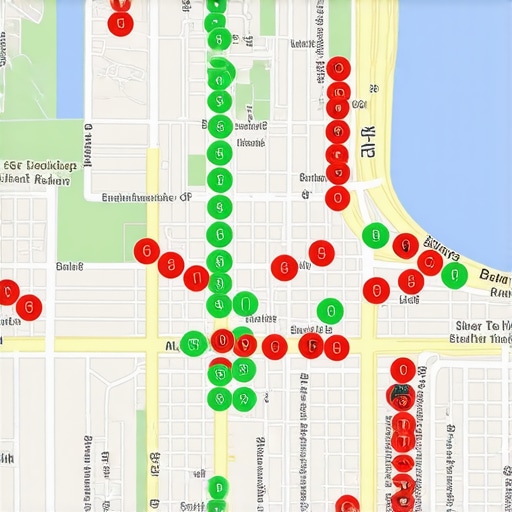
I don’t make a single move without looking at a local ranking grid. Tools like Local Falcon or BrightLocal’s Local Search Grid are my go-to because they show you a 13×13 or 15×15 map of your city with ‘pins’ showing exactly where you rank in every neighborhood. It’s the only way to see the best way to track your map rank across a whole city. If I see a sea of green dots around my shop but a wall of red dots to the North, I know exactly where my next localized blog post or geo-tagged photo needs to focus. I personally use the 1×1 mile grid setting because it reveals the micro-competitors you didn’t even know were stealing your leads.
How do I maintain my map position over the long haul?
The secret is ‘The Friday Audit.’ Every Friday, I spend twenty minutes doing three things: I reply to every single review (even the ones without text), I upload three photos from the week’s jobs, and I check for ‘suggested edits’ from competitors. Joy Hawkins, a renowned local SEO expert at Sterling Sky, has frequently pointed out that user-suggested edits can change your business category or phone number without you getting a notification. If you aren’t vigilant, a ‘helpful’ competitor can mark you as ‘Permanently Closed’ while you’re out on a lunch break. This consistency is the foundation of Google Maps optimization that actually lasts.
The Future Is Already Here and It’s Called SGE
We are moving toward a world where Google’s Search Generative Experience (AI) will summarize your reviews before a customer even clicks your profile. My prediction? Traditional keywords will matter less than ‘sentiment keywords.’ If fifty people mention your ‘fast response time’ in their reviews, the AI will tag you as the ‘fastest’ in the city. This is why you need to master map pack SEO by encouraging customers to be specific in their feedback. Don’t just ask for five stars; ask them to mention the specific service they received. If you’re expanding, you’ll need to learn how to rank in the map pack for multiple cities by duplicating this sentiment-driven strategy across new territories.
If this sounds like a lot of technical overhead, you aren’t wrong. It takes time to do it right. Many of my most successful clients eventually realized they were better at their trade than they were at digital maintenance, leading them to seek out affordable local SEO services to dominate the 3-pack so they could get back to the actual work. My advice for this week? Take ten minutes and learn how to audit your business profile for consistency errors in 10 minutes. It’s the quickest way to find the ‘leaks’ in your local authority before they cost you another lead. If you find a mess you can’t clean up, don’t hesitate to contact us for a deeper dive into your data.
The Hard Truths I Discovered After Analyzing 500 Map Listings
Over the years, I’ve realized that maps visibility isn’t about being the biggest business in town; it’s about being the most relevant. One of my biggest lightbulb moments was discovering that Google actually rewards the ‘activity’ of a profile over its age. If you haven’t touched your listing in months, you’re basically telling the algorithm you’ve retired. Another lesson? Don’t ignore the technical ‘debt’ on your site. You need to audit your business profile for consistency errors in 10 minutes to ensure that your NAP (Name, Address, Phone) data is bulletproof. If you’ve been searching for a professional seo service local to your market, you likely already know that consistency is the bedrock of authority. Finally, I learned that local intent is highly volatile—what works for a plumber in Chicago won’t necessarily work for a baker in a small town.
Tools and Resources That Actually Help My Profile Win
I don’t fly blind when I’m working on a client’s map pack seo. I rely on a small, trusted circle of tools. For visualizing proximity, Local Falcon is indispensable because it shows the actual reach of your business pin. I also religiously follow the Sterling Sky blog; Joy Hawkins and her team are the only ones I trust for data-backed local SEO experiments. When it comes to aligning my website with my map listing, I always double-check that your local landing pages must match your business profile data exactly. If there’s even a slight mismatch in the address or the way a service is named, you’re leaking authority. For those who want professional help to rank higher in 3 pack rankings without the corporate price tag, exploring affordable local seo services to dominate the 3-pack can save you dozens of hours of trial and error.
Build Your Digital Fort That Competitors Can’t Knock Down
The journey to the top of the search results isn’t a sprint. It’s a series of small, intentional actions that build a wall of trust around your brand. Every photo you upload, every review you respond to, and every technical tweak you make contributes to your long-term success. Don’t let the technical jargon intimidate you. Start with one thing today—whether it’s renaming a photo or checking your categories—and watch how it impacts your google maps optimization over time. You have the tools, the knowledge, and the proof that it works. Now, go take your spot in the 3-pack. What’s the weirdest photo you’ve ever uploaded that actually got views? Let me know in the comments below!