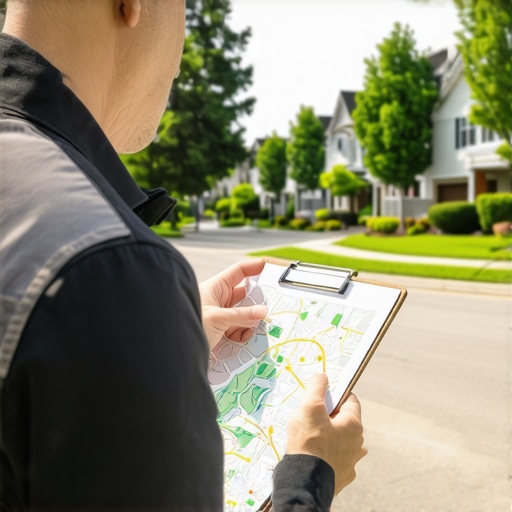
How Pest Control Companies Win the Neighborhood Map War
The “Four-Minute” Window: Why the 3-Pack is Non-Negotiable
In the pest control industry, marketing isn’t just about brand awareness; it’s about tactical availability at the exact second a crisis occurs. Consumer behavior research indicates a phenomenon known as the “Four-Minute Window.” When a homeowner spots a cockroach scuttling across the kitchen floor or discovers a wasp nest hovering above the front door, the time between discovery and the first phone call is often less than four minutes. In this high-urgency, high-intent environment, the user isn’t scrolling through pages of organic search results. They are looking for the most immediate, credible solution – which, in 2026, is exclusively found in the Google Maps 3-Pack.
If your business does not appear in those top three spots, for all intents and purposes, you do not exist to that customer. The Google Business Profile (GBP) has evolved into the single most important factor for local discovery. It is no longer a secondary directory listing; it is your primary lead generation engine. To capture these high-value leads, you must understand how to rank higher in the Google Maps 3-pack today, moving beyond basic setup into aggressive, data-driven optimization.
Winning the “Map War” requires a shift in perspective. You aren’t just competing against other local exterminators; you are competing for Google’s trust. Google wants to provide the most relevant, proximate, and reliable answer to a frantic homeowner. Dominating this space requires a mastery of google business profile seo to ensure your company is the one that gets the call during that critical four-minute window.
Beyond NAP: Advanced GBP Optimization for 2026
For years, the gold standard of local SEO was “NAP” consistency (Name, Address, Phone). While still foundational, NAP is now the bare minimum. To outpace competitors who are also maintaining consistent data, you must dive into the technical nuances of profile optimization. This starts with category selection. While “Pest Control Service” is the obvious primary category, the real advantage lies in your secondary categories and attributes.
In 2026, Google’s algorithm places immense weight on “Service Attributes.” If a customer searches for “termite inspection,” a company that has explicitly verified “Termite Control” as a service attribute – backed by relevant content – will outrank a generalist every time. Differentiators like “Bee Removal,” “Rodent Control,” or “Emergency Services” must be selected and detailed within the dashboard. However, a common mistake is over-optimizing the business description with a laundry list of keywords. Research from industry leaders like Townsquare Interactive suggests that treating the description like a high-conversion sales pitch is far more effective than keyword stuffing. Your description should focus on your Unique Selling Proposition (USP) – such as “Eco-friendly treatments” or “Same-day service” – rather than a comma-separated list of zip codes.
Furthermore, the “Business Name” field remains a point of contention. While it is tempting to add “Best Pest Control [City]” to your name, this is a “black hat” tactic that frequently leads to profile suspensions. Instead, focus on legitimate rank higher on google maps strategies that leverage your actual brand authority. Google’s AI is now sophisticated enough to detect “spammy” naming conventions, and the risk of a hard suspension far outweighs the short-term ranking boost. Authentic optimization involves a holistic approach to the profile’s technical health, which is why utilizing a google maps ranking service has become a standard practice for multi-location pest control firms looking to maintain a clean, high-performing presence across several territories.
The Review Psychology & Ranking Signals
Reviews have evolved from mere social proof into active, weighted ranking signals. It is no longer enough to have a high star rating; the *content* of those reviews is what moves the needle. This is known as “Review Semantic Density.” When a customer leaves a review that says, “Great service,” it helps your reputation. When a customer leaves a review that says, “The best bed bug treatment in Charlotte, they arrived on time and the exterminator was very professional,” it tells Google’s algorithm exactly what you do and where you do it.
Google’s natural language processing (NLP) capabilities analyze these reviews to determine relevance for specific long-tail queries. If your reviews are dense with keywords related to “pest control,” “ants,” “spiders,” and specific neighborhood names, your proximity and relevance scores increase. This is the “superpower” of GBP ranking. You should actively encourage customers to mention the specific pest they were dealing with and the neighborhood they live in. This creates a feedback loop of local relevance that is nearly impossible for competitors to beat through traditional SEO alone.
To maximize this, businesses must understand the review psychology that gets real customers writing 5-star reviews every time. It involves timing the request to the “moment of relief” – the second the technician confirms the pests are gone. By securing these detailed, keyword-rich testimonials, you are essentially crowdsourcing your local SEO efforts to your satisfied clients.
Visual Proof & The “Storefront Window” Strategy
In a service-based industry like pest control, your Google Business Profile is your storefront. Customers cannot walk into a physical office to judge your quality; they judge it through your photos and posts. High-resolution, branded imagery is a trust signal that converts views into clicks. Photos of clearly marked trucks, technicians in clean uniforms, and “before and after” shots of sealed entry points provide the visual proof nervous homeowners need.
However, many companies fail to realize that photos also contain metadata and visual AI signals that Google uses to verify your location and service type. If you are uploading stock photos, you are missing an opportunity. Real photos of your team working in the local community anchor your business to that specific geography. If you find that your visual content isn’t moving the needle, you should investigate why your high-res photos aren’t helping your map pack rank, as issues often stem from a lack of geo-relevance or improper formatting.
Additionally, the “Google Posts” feature should be treated as a dynamic storefront window. Use this space to highlight seasonal offers – such as mosquito prevention in the spring or rodent proofing in the fall. These posts keep your profile “fresh” in the eyes of the algorithm. Frequent updates signal to Google that the business is active and responsive, which is a subtle but consistent ranking factor in the competitive pest control landscape.
The 2026 Spatial Search Shift: Advanced Tactics
As we move through 2026, the local search landscape is shifting from “keyword-based” to “spatial-based.” This shift incorporates three major new signals: Neighborhood Semantic Density, Verified Footfall, and Spatial Depth data. Google is increasingly looking at “real-world signals” to determine who belongs at the top of the Map Pack. Verified Footfall, for instance, uses mobile device data to see how many people actually visit your physical location or how often your service vehicles are detected in specific residential zones.
Neighborhood Semantic Density refers to how often your brand is mentioned in relation to specific local landmarks and micro-neighborhoods across the web. To win this “Map War,” you must ensure your business is mentioned on local community blogs, neighborhood association sites, and local news outlets. This builds a “spatial web” around your business that proves you are a dominant local player. Because these signals are complex to manage, many owners are turning to advanced local seo tools to track their “geogrid” rankings – the ability to see exactly where their visibility drops off street-by-street.
Preparing for this future means preparing your map listing for the 2026 spatial search shift by focusing on hyper-local relevance. It’s no longer about ranking in “Chicago”; it’s about ranking in “Lincoln Park” and “Wicker Park” simultaneously. This requires a granular approach to content and backlink profiles that emphasizes local geography over broad industry terms.
Avoiding the “Filter” & Recovering from Suspensions
One of the most frustrating experiences for a pest control owner is the “filter.” This happens when Google decides your listing is too similar to another or that your service area is overlapping in a way that looks suspicious. “Cookie-cutter” city pages – where you simply swap the city name on identical content – are the primary cause of being filtered out of the Map Pack. Google’s helpful content updates have made it clear: if the content doesn’t provide unique value to the local user, it won’t rank.
Even worse than the filter is the dreaded suspension. Pest control is considered a “high-risk” category by Google due to the volume of lead-generation spam. If your profile is suspended, you must act immediately and methodically. This involves a full audit of your compliance with Google’s Terms of Service. Using a google business profile audit tool can help identify the specific red flags – such as an unverified address or conflicting data on third-party directories – that triggered the suspension. For a step-by-step recovery plan, refer to our guide on steps to take immediately after your listing goes dark. Avoiding these pitfalls is essential for maintaining the “always-on” presence required to capture those four-minute leads.
Measuring ROI & Conclusion
Ultimately, the success of your Google Business Profile isn’t measured by where you sit on a spreadsheet, but by the volume of calls and direction requests you generate. In the pest control world, a “direction request” often signifies a customer looking for your office to drop off a pest sample, while “click-to-call” is the ultimate conversion metric. By focusing on the data-first approach highlighted in Growth Foundry case studies, companies can dominate the top of search results across multiple locations, turning their GBP into a predictable revenue stream.
The “Neighborhood Map War” is won by those who combine technical precision with an understanding of human psychology. From optimizing for 2026 spatial signals to leveraging the semantic power of customer reviews, every element of your profile must be tuned for maximum local relevance. If you are ready to stop losing leads to the competition, it is time to invest in a professional google maps ranking service that understands the unique pressures of the pest control industry. Audit your profile, engage your customers, and claim your spot in the 3-Pack today.